From Aluminum to Compostables: Redesigning Coffee Capsules for a Lower-Carbon Future
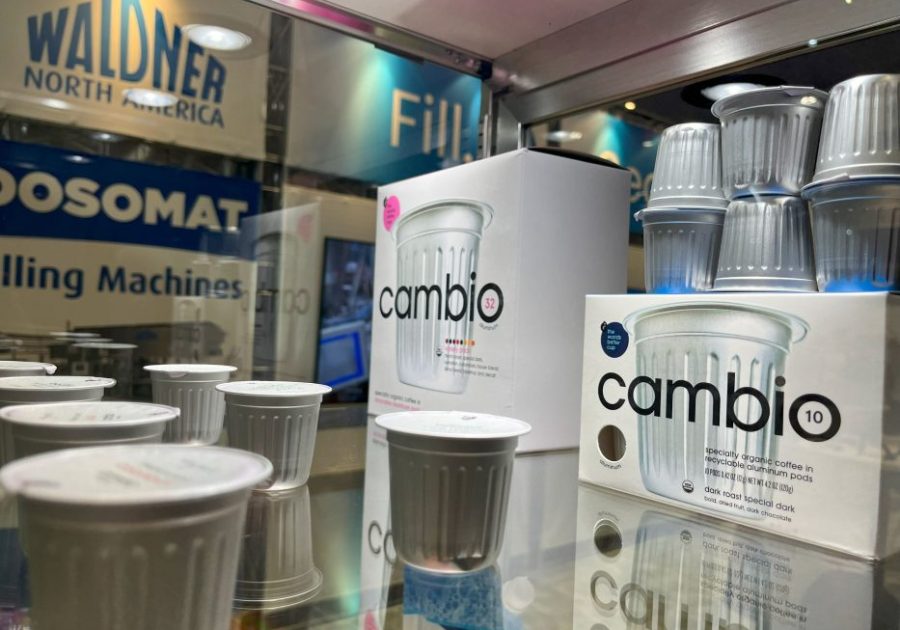
Credit: Cambio Roasters
Once seen as a symbol of conveniencedriven waste, coffee capsules are undergoing a sustainability makeover. Packaging developers are replacing traditional mixed laminates with recyclable materials and certified compostable solutions — while pushing brands to rethink not only what pods
are made from, but also what happens after they are used.
As consumers become more conscious of the environmental impact of their purchases, expectations around coffee have expanded beyond taste and convenience. Sustainability is increasingly being judged across the entire
value chain, from sourcing and production to packaging and end-of-life management.
“Coffee must be sustainable inside and out, starting with the way it is grown, sourced, staffed, manufactured and more recently how it is packaged,” commented Nerida Kelton, vp for sustainability at the World Packaging
Organization.
The industry’s search for a greener pod has produced not one answer, but several. Companies are pursuing a wide range of solutions to reduce
the environmental footprint of single-serve coffee, including recyclable aluminum capsules, compostable and fibre-based formats, and even
packaging-free concepts such as compressed coffee tabs.
However, despite their different approaches, market players agree that sustainability initiatives have become a mandatory requirement for modern, single serve coffee companies.
“The single serve coffee category is entering a period where sustainability is shifting from a marketing differentiator to a business requirement,” said Kevin Hartley, founder and CEO of Cambio Roasters.
Aluminum is Still the King
From a commercial perspective, recyclable aluminum capsules remain among the strongest options for premium single-serve coffee, said Nandini Roy Choudhury, a senior analyst with Future Market Insights.
Still, the sustainability of aluminum capsules largely depends on the availability of appropriate infrastructure.
“Their environmental performance depends heavily on collection and recycling participation, but where take-back schemes are convenient and well communicated, aluminum can support a credible circularity story,” Choudhury explained.
There are several reasons why Cambio Roasters ultimately settled on aluminum, Hartley said. “Aluminum is infinitely recyclable, allowing our pods to go on to become another product. It is often referred to as the ‘magic metal’.”
At the same time, when it comes to preserving product quality, aluminum is still widely seen as the undisputed champion.
“It also blocks light and oxygen, allowing for almost zero percent oxidation. In fact, a recent study found that aluminum is seven times less permeable than plastic pods. This means our gourmet coffee stays fresher longer, which equates to a longer shelf life,” Hartley added.
In general, aluminum pod recycling brings sustainability advantages beyond the capsule itself.
Significantly less energy is required to produce new aluminum from recycled materials than from raw bauxite, Kelton said. “So, we need to see more brands incorporating higher percentages of recycled content into their capsules. We also need to see them develop collection programmes to capture this valuable material and reuse it wherever possible,” she added.
A Compostability Paradox
Recent years have also witnessed the growing popularity of compostable and fibre-based formats. These solutions are promising because they align with consumer expectations for natural, lower-plastic packaging.
“However, their success depends on whether the material performs well during brewing, protects coffee quality, and can actually be processed through available composting systems. If a compostable pod ends up in general waste, the environmental advantage becomes much weaker,” Choudhury shared.
But material innovation alone cannot close the sustainability gap. Without the right end-of-life pathways, even the most advanced compostable solutions risk falling short.
“If you are moving to certified compostable capsules – home compostable – then you need to ensure that the consumers who buy them have access to home composting. Otherwise, they will end up in the wrong bin as well,” Kelton said.
There have been some tangible developments in this segment. For example, Clean Cups, a Dutch multi-company R&D initiative focused on developing a home-compostable coffee capsule compatible with Nespresso systems,
recently demonstrated that such capsules can be manufactured at industrial scale using CCM (calcium citrate malate) technology.
Traditional Nespresso-compatible capsules solve the barrier challenge with aluminum or high-barrier plastics, but these materials are not home compostable, commented Paul Schildmeijer, a spokesperson for Clean Cups.
Most compostable materials are more permeable than aluminum and conventional multilayer barrier plastics. Biomaterials can also affect flavour in certain circumstances, while the combination of water, temperature and
pressure during brewing can cause the structure to deteriorate too quickly, creating taste and logistical challenges.
The challenge was therefore to create a homecompostable structure that could preserve freshness and shelf life without sacrificing biodegradability, Schildmeijer explained.
However, the Clean Cups project also showed that overcoming technical challenges is only part of the equation.
The consortium decided to postpone commercialisation despite successfully meeting its technical objectives. According to Schildmeijer, multiple factors contributed to the decision, although regulatory uncertainty was likely the
dominant reason.
In addition, certification requirements create cost and execution risks, while waste-management infrastructure remains a critical weakness.
Market conditions for compostable solutions have also become less favourable. Since the project began, the economics of sustainable packaging have tightened significantly, with biomaterial costs increasing by up to 50 percent
according to Schildmeijer.
“The Clean Cups project reinforced something that many in the coffee- ackaging industry already suspected: home-compostable capsules are technically feasible, but their success depends less on materials science than on the broader waste-management and regulatory ecosystem,” Schildmeijer said.
Packaging-Free Coffee Formats
Packaging-free compressed coffee tabs represent another promising approach to improving the sustainability of the single serve coffee segment.
This segment is also seeing notable developments. For example, Lavazza recently launched Tablì, its new brewing system based on 100 percent coffee tablets, in the US.
The tablets, made from compressed ground coffee without a coating, binder or gelatin, can only be used with Lavazza’s Tablì coffee machine. Each tablet is marked with the words “100% coffee.” Tablì has been well received in the Italian market, allowing the company to expand the project to the US.
Compressed coffee tabs look promising from an innovation standpoint. However, commercially, the approach remains at an early stage, Choudhury said.
Beyond environmental benefits, manufacturers will need to convince consumers to adopt new brewing systems while ensuring competitive
pricing, wide machine availability, and a user experience that matches the convenience of established single serve formats.
“It usually requires new machines or new brewing systems, which means adoption will depend on taste, convenience, price, machine availability and consumer willingness to switch platforms,” Choudhury added.
Sustainability Claims Face a New Reality Check
Regardless of which path market players choose, the single serve coffee category is entering a phase where sustainability claims must pass a reality check, Hartley said. “The era of broad sustainability language is ending. Verification, certification, and transparent consumer instructions have been and will become even more increasingly important,” he said.
“Those that succeed will likely be the brands that can prove environmental performance, not just claim it,” Hartley added.
Analysts agree that sustainability in the single serve coffee segment will increasingly become evidence-based.
“Sustainability in single serve coffee will increasingly be judged not by whether a capsule is theoretically recyclable or compostable, but by whether it is actually recovered, recycled, composted or avoided in practice,” explained Choudhury.
But proving sustainability will require more than better labels and certifications. The next challenge is ensuring that consumers have the tools, information and infrastructure needed to turn sustainable intentions into real-world outcomes.
A significant part of this effort will involve ensuring that customers are ready to participate in sustainability initiatives.
The single serve category is working hard to find more sustainable solutions that can be collected, recovered, recycled, and/or reprocessed, Kelton
admitted. “The hard part is making sure that consumers are taken on the journey and that they are engaged in the programme. Consumers need to understand the why, the how, and the outcomes, and then they will want to lower their own coffeebased carbon footprint,” she said. “The collection programme needs to be mindful, intuitive, easy to use and access, and also include an incentive or reward-based system for contributing.”
The next phase of improvement will be less about inventing a perfect capsule and more about building a workable circular system, Choudhury said. “The companies that perform best will be those that combine material innovation with convenient collection, transparent labelling, consumer education, and partnerships with waste-management and composting networks,”
she added.
- Vladislav Vorotnikov is a Batumi, Georgia-based multimedia B2B freelance journalist writing about the tea and coffee industries since 2012.
TopicsPeople
Kevin Hartley Nandini Roy Choudhury Nerida Kelton Paul Schildmeijer
OrganisationsCambio Roasters Clean Cups Future Market Insights World Packaging Organization