
Tea Cultivation in France, a New Agricultural Micro Segment
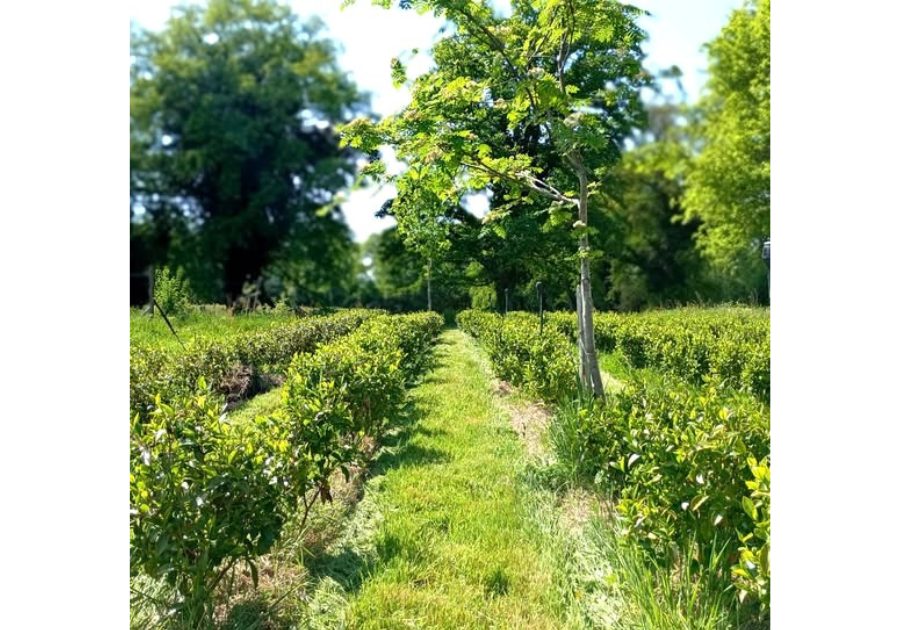
Credit: Barbara Dufrêne
From its homeland in faraway mountain areas to new regions, tea remains resilient and continues to adapt. Tea origins such as China, India, Vietnam, Laos and Myanmar have allowed a rich number of varietals to evolve over several thousand years, from big leaf camellia trees in the mountains to small leaf bushes in the lower hills. After the plants’ domestication by Chinese imperial agriculture, Camellia sinensis spread to neighbouring kingdoms, namely Japan
and Korea, in the wake of Buddhist monks. Much later the cup was introduced to the West, where it attracted immediate attention and for many decades was imported mainly from China.
During the colonial times tea growing was fostered primarily in India, Kenya, other African countries, and in Sri Lanka – all in the tropical climate zone, ie, between the Tropic of Cancer and the Tropic of Capricorn. In the 19th century,
tea growing was brought to South America, and has since prospered in Argentina and is being revived in Peru. There is some tea growing in the USA, in South Carolina, Louisiana and Hawaii. Tea has also been introduced to Australia
and New Zealand by Taiwanese and Japanese operators. Tea was furthermore brought to Iran and Turkey and Georgia, by far-sighted agrieconomical politics to cater to the home markets demands.
Within the past 15 years or so, some pioneers introduced tea growing in several European countries as a novel botanical experience. Given the vitality of this new agri sector, the Tea Grown in Europe Trade Federation was founded
in 2016, with membership in France, Germany, Netherlands, Switzerland, Italy, Portugal, Turkey, Georgia and the United Kingdom. It works as an overhead structure to assist with finding plant material supplies, to foster learning, and to exchange expertise. This new associative structure was launched by French
tea-growing pioneer Denis Mazerolles. France currently has the biggest number of tea garden memberships.
The French Tea Growers
What motivates a flock of agricultural engineers, botanists and herb experts and genuine tea lovers to invest their time and money into tea farming and tea processing? There are, in fact, multiple reasons: the highly developed premium tea market in France; the awareness of the many parallels between premium teas and premium wines, with the sommelier activity spreading from wine to tea; an array of tea tasting competitions; many books about tea and a host
of tea-travel offers to the homelands of tea, all of which generate a fascination for crafting local French teas. There is also the attachment to regional terroirs, which offer tea-compatible climate conditions in line with the attractiveness
of a new crop for serving niche markets in a country renowned for its gourmet food. There is also a perceptible post-pandemic confinement effect behind several projects.
For all the people involved in ongoing and nascent tea producing operations, they appear to wish to gratify some professional activity based on knowledge and competence, in close contact with nature; excitement to see their plantations unfold acre by acre, their tea bushes growing taller, their yields gradually increasing towards full maturity after some seven years, and to sell their farm processed made teas for hefty prices to get brewed into premium cups.
According to Denis Mazerolle, hailed again as the pioneer of the recent French tea-growing movement, and the owner of the Filleules de Fée Tea Estate in Brittany, there is plenty of highly qualified tea-compatible territory available in
metropolitan France to allow this new trend to prosper. These terroirs are mainly located in Brittany and the Pyrenees area, where acidic soil abounds and maritime winds bring enough humid clouds and prevent stark winter cold. Other southern locations in Occitanie, Corrèze, and Normandy are also on the tea garden list.
All these places are small-scale set ups in highly specific microclimate conditions.
For such an undertaking, a key issue is the choice and procurement of the plant material, be it seeds or cuttings, using commercial nurseries and agri-tech colleges and university campus teams to assist and cooperate enthusiastically. The tea plants thriving in French soil today come mainly from China, Taiwan, Georgia and Turkey. There are also three French cultivars
that have been discovered in a magnificent old botanical garden, belonging to Trevarez Castel in Brittany, specialised in Camellia Japonica, the flowering species. Among the latter, a few Camellia sinensis bushes that also had been
planted some 80 years ago, have since prospered and fully adapted to the local soil and climate conditions. They have provided seeds and cuttings since their identification as tea plants some 15 years ago by Mazerolle. These hardy
cultivars with lush fragrant leaves are: Trevarez, Kemper and Blavezh2. The cups brewed from the small harvests so far available reveal intense and
unique flavour notes.
A further choice that must be made at every harvest is about which type of tea to process the leaves into, with the manufacturing always done in the planters’ own workshops, as an artisanal craft. Most of them process all tea colours available – black, green, oolong and white tea – with an overall annual output that is estimated to be around 1,000kg in 2025. These incredible French teas sell usually in 10g packs, all are fresh and beautiful, of course very expensive and sell out within weeks. By 2030, the plants will have mature yields, and the expected annual French tea production should total two to three metric
tonnes of top premium leaf.
New Tea Gardens and Their Owners
Every one of these new tea-garden owners calls themself a ‘tea maker’, a first in French agriculture, all use a fully organic approach and are proudly in charge of the complete value chain from the field to the cup.
Clustered in Brittany with its smooth maritime climate, granitic geology and gulf stream neighbourhood are several tea gardens:
• Filleules des Fées – established by Denis and Weizi Mazerolles in Trevidic, on the banks of the River Blavet. First planting was in 2005, with intensified planting from 2019 onwards, covering step by step some 40 acres with 2,000
plants each. They run the biggest and oldest tea estate in France, strictly organic with a major share of French cultivars and they also make seeds and cuttings available.
• Le Moulin de Kérouzéré – established by Michel Thévot with tea seeds from Yunnan that germinated extremely fast and well, which allowed him to plant the first set of 2,000 seedlings in 2018. They grew incredibly fast in the ideal microclimate, thus yielding some prize winning cups after only two years of
growth, which is truly exceptional.
• Aventure Oolong – established by Jakez Hubert in a granitic rock surrounding near the Ellé river, who planted the first cuttings in 2023 and since then has been able to purchase some of Denis Mazerolle – his neighbour’s – leaf to
process into unique and premium oolong teas in his workshop.
• Les thés de Kérizel – established by Jean d’Estaintot, who took over and enlarged a tea estate launched by a British tea lover in 2015. Today, there are several hectares planted with mature bushes, and the first commercial harvest in 2023 fetched two awards. Clustered close to the Pyrenees, with sunny and
sheltered exposure and good soil, the tea gardens in this region include:
• A Capella – established by Jean Marc Sanchez in Roussillon, created from scratch in 2020, by planting over a three-year period 8,000, 12,000, and 15,000 bushes on a 16 acre field, sitting below a photovoltaic shield, giving the bushes an ideal protection from draughty winds. This unusual setup takes advantage of the empty space below the energy capturing panels which create a protected area and shield the bushes; carried out swiftly and state of the
art by this agri tech engineer, who wanted to creatively innovate after the frustration of the confinement. To cope with labour shortages, he has designed small machinery to weed between the rows and adjusted the plucking table to a shearing device. In 2025, he proudly claimed a harvest of 400kg of made teas, and two awards.
• Ilgora Herriko – established by Mikel Escamadon in 2020, with some 5,500 plants on one hectare, where he proudly produced his first small harvest in 2023 and plans to make his living with this small plot.
• Les Terrasses de l’Arrieulat – established by Lucas Ben Moura in 2022. Fascinated with tea making since a first agri-tech training experience in Laos and proud to plant on a lovely slope set aside for him on his grandfather’s farmlands; a very first harvest of 50kg from around 5,000 young bushes
allows him to calculate that he will achieve profitability swiftly.
Normandy is also part of this new trend. Located close to the sea with good sunshine and enough rain, is Jardins de Thé, established by Gaëlle Rousseau. Not far from Deauville in a traditional farm surrounding, Rousseau rents a
few hectares of sandy loam lands and has planted several thousand bushes since 2020. Her second challenge has been to plant some 1,000 bushes
in Paris in a green area not very far from the Champs Elysées, where she rents a small plot and offers visits and an introduction to tea making. There are a few more new tea farmers, who follow in the footsteps of those noted above and
are preparing forthcoming harvests.
Perspectives for this New Agricultural Micro Segment
When asked for their views, both senior French tea-growing pioneer Denis Mazerolle in Brittany, who has structured this new segment and made advice and mutual assistance available, and senior premium tea consultant Lydia Gautier, in Paris, who has launched her own premium tea brand, works with luxury tea outlets, has authored a dozen tea books, and planted her own small tea bush plot in Corrèze – confirm that they have been closely following this new development from inception. Both give full support to this new tea-growing movement, which targets a niche market of super premium unique single origin handcrafted cups, whilst fully respecting nature and operating with passion and competence. They consider that the required investments over time can generate profitable results for businesses with a minimum of 1,000 bushes, with high quality cultivars and appropriate premium processing.
Today these rare premium teas will sell at around 3000€/kg, and are marketed in 10g sachets, mostly directly by the growers, at the farmgate or via the internet. Most of these small operators will find additional income through
training and tasting sessions and agri-tourism, some will also grow herbs or other complementary food crops with a focus on having labour employed throughout the seasons, for building up stable and competent teams. Enthusiasm prevails all over and stimulates innovative devices and new
ways of processing this untraditional crop, which continues to fascinate.
These new French teas belong to a new model of micro sector farming and are in no way meant to compete with the premium teas from traditional origins. While paying genuine tribute to the teas of the Far East origin countries, the French tea growers consider that their innovative cups enhance the brew’s visibility and promote tea consumption with new consumers, by spreading
knowledge and sharing values with a special target on the younger generations.
- Barbara Dufrêne is the former Secretary General of the European Tea Committee and editor of La Nouvelle du Thé. She may be reached at: b-dufrê[email protected].
