
Cupping vs tasting coffee as a professional — the human factor
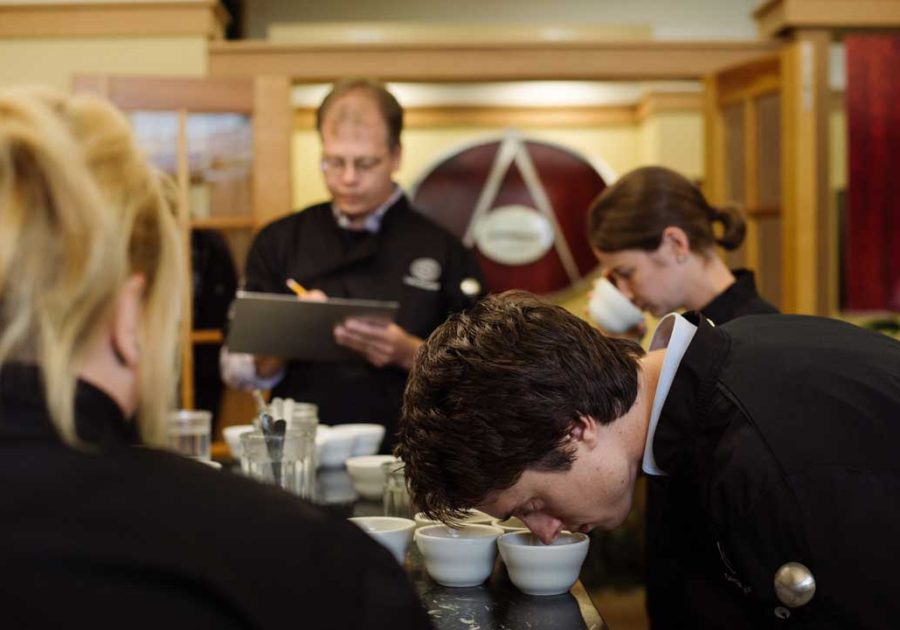
Image credit: Coffee Enterprises
The evaluation of coffee requires human intervention as no machine can match or come close to the olfactory bulbs and gustatory cells common in humans. In addition, humans can be trained in the how to’s in tasting and smelling coffee and can continue to add to their sensory library over a lifetime.
The use of artificial noses and other chemical evaluation machines may be helpful under certain circumstances, but to date they are quite limited in their breath and depth of coffee’s sensory qualities. In addition, it is recommended that cupping and tasting be conducted with multiple trained professionals at the same time. Learning from each other and having the ability to describe, question and learn new sensory flavours make for better cuppers and tasters. Each person shares his/her library of tastes and smells that they have accumulated over their lifetime. Some tasters may have an acute ability to discern spices while others may have a focus on sweetness or savoury flavours. Both are valuable tools of the trade.
Cupping is the term used to describe the process of sensory evaluation in coffee usually prior to purchasing the coffee in commercial situations. Coffee is traded in lots of about 38,000 lbs (about twice the weight of a school bus) per container.
In cupping, a green (unroasted) sample (1-2 lbs) of coffee is sent to a buyer who will put a sample (100 grams) into a small benchtop roaster. The coffee will be intentionally under-roasted, which will allow the cupper to more easily determine if there are any faults or defects in the sample. A fault is usually a sensory attribute which will cause the coffee to fail and not be purchased. Common faults are fermentation, phenolic, dirty, full sour etc. Taints are subtle sensory characteristics that may be acceptable to the buyer if detected in minor moderation. The cupper usually tastes five to nine cups of coffee at a time which has been prepared by direct infusion. The grounds are sniffed, and the sample cups are quickly tasted and spat into a receptacle.
Cups are evaluated and consistency between cups is important. The coffee may also be re-cupped after it has cooled. If there are no faults or taints in the green coffee, it is considered sound and may be purchased. The same sample may later be roasted a second time to a different degree in order to bring out other characteristics in the coffee. When the full shipment of coffee arrives at the roaster, another sample may be drawn and the process repeated to make sure the sample meets the shipment as specified.
Tasting the coffee is the process used after the coffee has been purchased and brewed in a commercial brewer. The purpose is to determine how the coffee is to be used (as a straight or in a blend) and at what roast level, light, medium, or dark. In addition, the percentage of each coffee used in a blend creates the recipe. Mocha Java is touted as the first blend of coffee created.
Blending coffees is one of the most important skills a professional needs to master. There are many reasons to create a blend which include: creation of a new flavour, cost containment, availability of coffees, swapping out a coffee that may have a problem, proprietary recipe, etc. The strength of the coffee is also determined by the ratio of water to grounds being brewed.
Cuppers and tasters should be trained in how to evaluate, describe, score and remember how each coffee sample performed. This is not a part-time job and requires constant diligence and lifelong learning. It can be a joyful experience but also a necessary chore.
Daniel C Cox is president of Coffee Enterprises, an independent company providing consulting, technical laboratory services and business intelligence to the coffee and tea industries.