Beyond Chemicals
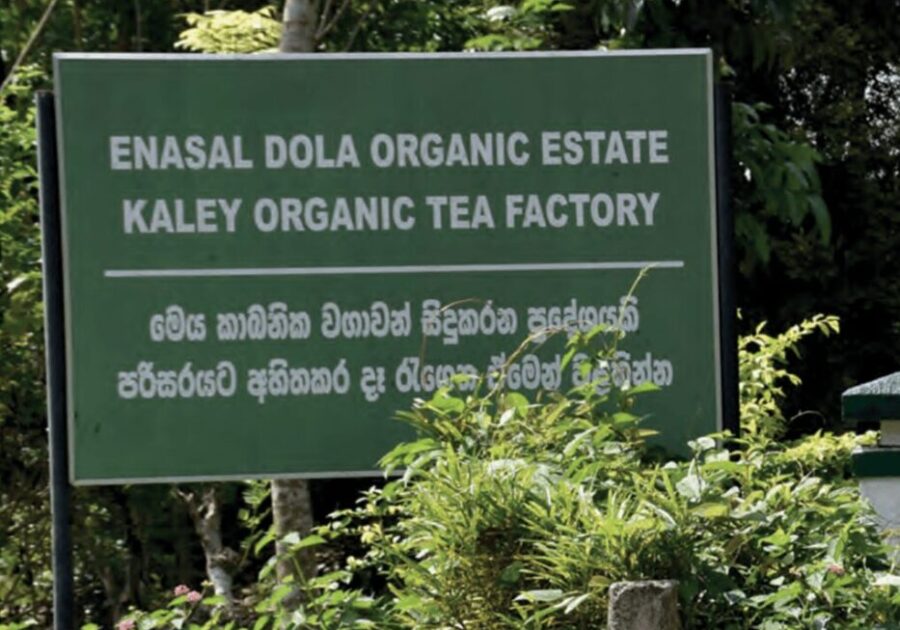
Kaley Tea clearly designates its organic factory. Image credit: Yumi Nakatsugawa
As a growing number of producers transition away from chemical pesticides and herbicides because of the negative effects on people and the planet, the future is looking bright for sustainable and organic coffee and tea. By Gordon Feller.
A growing number of tea and coffee producers are shifting away from chemical pesticides and herbicides, in large part due to the many ways that unsustainable farming practices poison soil and water; deplete the health of humans and animals; threaten crop yields; diminish long-term food security. In contrast, these pioneering farmers now see regenerative agricultural practices as the key to protecting the environment while empowering farmers.
Researchers at universities and in government agencies are conducting studies that verify which non-chemicals practices are having the greatest positive impact. Agroforestry and shade systems are central. Compost and organic inputs build resilient soils. Economic returns improve via higher yields, reduced inputs, and premium markets. Co-learning and farmer involvement remain vital for scaling.
The evidence is now overwhelming: Long‑term adoption of regenerative methods is stabilising yields, cutting pesticide use, and rebuilding soil quality. Systems are being built which resemble ‘tea forests’, and these are shown to promote deep rooting and ecological balance via enhanced soil fertility, and richer ecosystem dynamics. Cooler climates and low-input systems (as in the Republic of Georgia and Southeast Asia) show healthy soils, reduced pesticide use, and resilience to pests. Significant reductions in carbon footprint and pesticide toxicity are being achieved.
To understand how and where coffee and tea producers are succeeding in going beyond chemical, consider the International Coffee Organization’s (ICO) path-breaking report, “Beyond Coffee: Towards a Circular Coffee Economy”. It explored regenerative agriculture and circular economy principles, and included coffee by-product valorisation (biofuels, compost, cosmetics). Importantly, it issued policy guidance along the coffee chain – from farming to post-consumption – to enhance the two things most needed to get beyond chemicals: resiliency and sustainability.
A short while after that report’s release, ICO published another special document, this one in partnership with the UN Industrial Development Organization. It outlined how to structure a global ‘Coffee Investment Vehicle’ to finance sustainable practices in the coffee value chain.
The Consumer’s Perspective
There are numerous factors pushing both consumers and producers away from chemicals and towards organics and more sustainable practices. One key factor is the growing awareness of the adverse health effects caused by exposure to agricultural chemicals. (See the Sidebar on the growing number of studies showing the impacts.)
The consumer demand side of the equation is certainly having an impact, not least on the desire amongst producers to move beyond chemicals. How seriously do consumers care about sustainable coffee production and processing practices, such as organic farming? One of the world’s three largest consulting companies, PwC, conducted its “2024 Voice of the Consumer Survey” ) to find out. An analysis of the data found something remarkable: “While cost-of-living pressures weigh, some consumers say they are willing to spend 9.7 percent more, on average, for sustainably produced or sourced goods, as almost nine-in-ten (85 percent) report experiencing first-hand the disruptive effects of climate change in their daily lives.” The survey collected the perspectives of more than 20,000 consumers from across 31 countries and territories. It found that almost nine-in-ten (85 percent) consumers are experiencing first-hand the disruptive effects of climate change in their daily lives and are prioritising consumption that integrates sustainability-focused practices.
Consumer demand for organics in the United States is growing faster than many had predicted. In 2024, total sales of certified organic products in the US reached a record USD $71.6 billion, with a growth rate of 5.2 percent, according to the Organic Trade Association (OTA). This growth rate was more than double that of the overall marketplace. Specifically, organic food sales totalled $65.4 billion, while organic non-food product sales accounted for $6.2 billion. Within those bigger totals, one number is notable and important here: organic beverage sales reached $9.5 billion.
Organic coffee beans are grown without chemical-based pesticides, herbicides, fungicides, or genetically modified organisms. Many organic coffee bean growers also employ sustainable practices like using renewable resources and conserving water and soil. Organic farming is on a strong upward trajectory – massive gains in the last two years – but still represents just ~2–2.1 percent of global farmland (~99 million hectares per statista.com and fibl.org).
Consider the trendlines for the organic farmland area under cultivation, from 1990 to 2023. Organic agriculture grew modestly from about 10 million hectares (ha) in 1990 to ~76 million ha by 2021. It then surged, over the next two years, to nearly 99 million ha.

Here are some of the key numbers pertaining to organic farming, as extracted from the datasets:
- 1990: approximately 10 million ha
- 2021: ~76.4 million ha (up 1.7 percent from 2020) (en.wikipedia.org, tdc-enabel.be)
- 2022: ~96.4 million ha (up 26.6 percent)
- 2023: ~98.9 million ha (2.6 percent)
Forecasts show global organic coffee market growing from ~$10.9 billion (2024) to >$18 billion (2029), ~10–13 percent CAGR.

Pesticide/herbicide use has shifted over time (from 1990 to 2022/2023) as measured by the total active ingredients. Such chemicals usage continues to climb, with no signs of leveling off. Pesticide use doubled since 1990, while herbicides now account for over ~50 percent of total active ingredient mass.

Here are some of the key numbers relating to pesticide use, as extracted from the datasets:
- 1990: ~1.85 million tonnes [mt] (based on doubling to 3.7 mt by 2022)
- 2021: 3.54 mt (up 4 percent from 2020, double since 1990)
- 2022: 3.69 – 3.70 mt (up 4 percent from 2021)
Herbicides (as a subset of the total data above)
Cindi Bigelow, CEO of Bigelow Tea, has a straightforward view regarding her eponymous tea company’s approach, “The farmers and gardens we have used for decades understand the importance of sustainability. They recognise the importance of maintaining plant and soil health which means following practices that minimize the use of any chemicals. However, we have heard that more and more gardens are learning the value of that kind of longer-term philosophy and modifying their methodology which is a win-win for the consumer and the gardens.”
According to Nathanael Lim, Euromonitor’s beverages insight manager, “climate change has posed challenges for coffee farmers, including lower production yields and a higher risk of pests.” He argues that, although an increasing number of farmers are adopting more environmentally friendly pesticides, “the overall adoption remains limited. To encourage broader use, governments should provide stronger incentives and raise awareness about the benefits of using less harmful alternatives. Lim said that in addition, closer collaboration between farmers and supply chain partners through sustainability programmes will be essential. “These efforts can help promote the use of safer pesticides and support the shift towards regenerative farming practises.
The ICO is making a move to be the clear leader here. ICO’s sustainability initiatives include flagship circular economy reports, financing vehicles, living income frameworks, and interactive sustainability tools. ICO’s organic coffee efforts cover certification infrastructure, cost-benefit analytics (via COSA), and market forecasting.
When it was jointly published by ICO and the International Trade Commission (ITC) in January 2024, “Beyond Coffee: Towards a Circular Coffee Economy” quantified that coffee processing generates over 40 million tonnes of waste per year — not a ‘cost’, but a resource ripe for valorisation in cosmetics, biochar, mushroom cultivation, and renewable energy. The report’s circular economy framework was tailored for coffee: waste elimination, material circulation, and ecosystem regeneration — all guided by intentional intervention. It shows how by-products can loop back as value-added products at origin. The report introduced the C4CEC platform, a live hub for sector-level case studies and best practices.
A Growing Number of Studies Verify Positive Impacts
Coffee studies
- “The Regenerative Coffee Investment Case” — This report is from the international nonprofit TechnoServe, with support from Nestlé, JDE Peet’s, and the Rudy & Alice Ramsey Foundation. It found many tangible benefits from regenerative coffee practice for farmers, businesses, ecosystems, and climate resilience. The study results span nine major coffee-producing regions, (technoserve.org).
- “Resilient coffee via improved agroforestry, soil & water practices”, in the “Journal of Agroecology and Sustainable Food Systems” — Agroforestry is a cost-effective strategy for climactic resilience; combining regenerative practices – shade trees, drought-resistant varietals, water conservation – offers synergistic benefits. However, there are knowledge gaps: integration of multiple practices at scale, especially for Robusta, and co-designed farmer-led research opportunities (tandfonline.com).
- “Open-access Agronomic practices toward coffee sustainability, a review” in “Review, Crop Science” — the focus in this study was on regenerative coffee farms with cover crops, rock-based minerals, reduced tillage, composting, and drone-assisted biological pest control achieved healthier soils, biodiversity gains, and 50 percent pesticide reduction. Shaded systems enhance soil moisture, reduce erosion, support microclimates, and maintain yield stability while boosting ecosysHtem services (scielo.br).
Tea studies
- “Addressing the Sustainability Issues in Tea Production in the Barak Valley (Cachar) of Assam, India, by Attending the Principles of Regenerative Farming Practices: A Ten Year Case Study on the Adoption of Inhana Rational Farming Technology,” in “Asian Journal of Environment & Ecology” — after a decade of regenerative Inhana Plant Health Management and on-farm compost use, tea output stabilised/increased despite regional declines; pesticide residue fell well below EU limits. Soil health improved, plant resilience against stress increased, and sustained yields confirm benefits in challenging environments (journalajee.com).
- “Development of Regenerative Tea Cultivation Models through Dual Approach of Soil and Plant Health Management towards Crop Sustainability, Soil Quality Development, Pesticide Reduction and Climate Change Mitigation: A Case Study from Lakhipara Tea Estate, Dooars, West Bengal, India”, in “International Journal of Environment and Climate Change” — when compared to non project fields, regenerative plots saw a +78 kg/ha yield vs −118 kg/ha loss, a 52–77 percent drop in pesticide toxicity, +6.7 percent soil organic carbon, and a ~65–70 percent lower carbon footprint (researchgate.net). These plots are cost-effective and sustainable without yield sacrifice.
Gordon Feller, based in California, travels the world reporting about innovations that can change our economies and strengthen small enterprises. Since 1980 he’s been publishing reports and magazine articles about coffee / tea innovations on five continents. He is both an ABE Fellow – Japan Fdn. and Global Fellow – The Smithsonian Inst. He can be reached at [email protected].
TopicsPeople
Cindi Bigelow Gordon Feller Nathanael Lim
OrganisationsBigelow Tea Euromonitor International Trade Commission (ITC)