Reconnecting with the Values of Sustainability
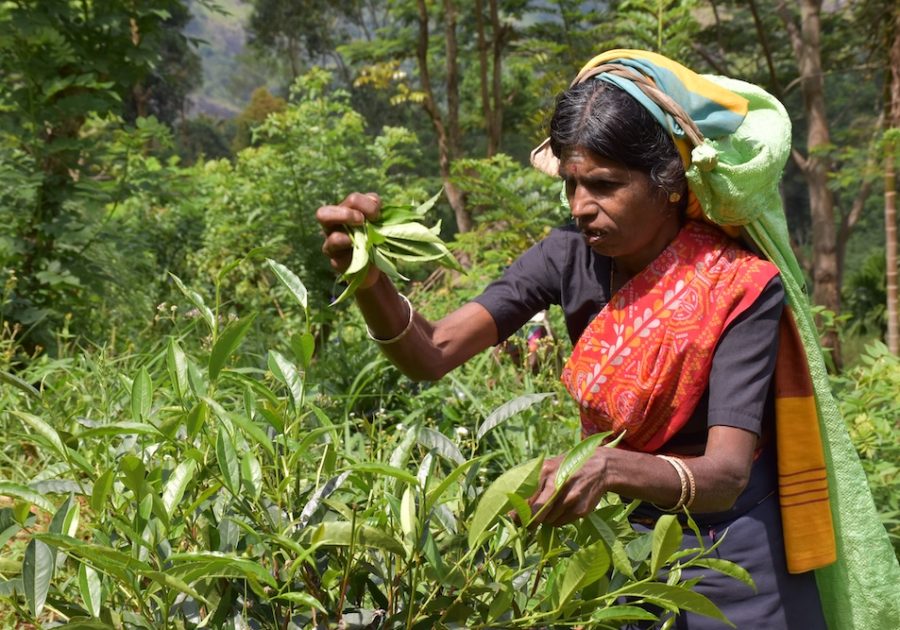
Tea plucker working on Monkeytail Tea estate in Sri Lanka. Image credit: Yumi Nakatsugawa
Sustainability has been part of the tea and coffee conversation for several decades, with the recognition that existing practices failed to address the environmental, social, and economic needs of these industries. Mitigating the risks of climate change remains a critical goal; however, it is vital that the industry considers the economic and social impact of implementing these environmental strategies. The complexity of finding these holistic solutions is extremely daunting, especially when attempted independently.
On a positive note, the tea and coffee industries worldwide are continuing to invest in sustainability strategies, acknowledging that significant environmental, social, and economic challenges remain. Certification bodies have been instrumental in highlighting the issues the industry faces, particularly at the producer level, and the potential solutions that could address them. This includes recognising the need to continually review and evolve initiatives to address today’s challenges.
One strategy that Fairtrade International has implemented to help identify shifting needs is the development of living income reference prices.
These reference prices are updated based on the existing farmer’s circumstances. For example, in Ethiopia, the price of coffee was adjusted in 2025 to reflect the inflation of on-farm production costs, as smallholder farmers experienced an inflation rate of 47.8 percent.
Regenerative agriculture has been increasingly identified as a proactive solution to address the challenges posed by climate change. Rainforest Alliance has been a strong supporter of this practice, including the recent development of a Regenerative Farming Certification. Data collection and analysis have become instrumental in evaluating whether the changes implemented have had the desired impact.
With the intent of deepening their knowledge of understanding the impact of regenerative farming, Nescafé, in conjunction with the Rainforest Alliance, collected monitoring and evaluation data across twelve countries. This included interviewing 3,800 farmers on the implementation of regenerative farming practices, household experience, and their overall experience with the Nescafé Plan. The goal was to distill key insights on regenerative agriculture, farm economics and farmer income. This data can then be used to target areas for adaptation.
Rainforest Alliance’s first certified regenerative farm was La Cumplida, a 2,200-hectare coffee farm in Nicaragua. Adopting the regenerative agriculture standard has already yielded positive results, including beneficial insects, increased bird species, slower erosion and stabilised microclimates.
Accurate data collection and transparent practices are critical to both identifying potential gaps and developing solutions to address them. This also helps ensure that corporations continually analyse the strategies they have implemented. It includes reflecting on the data and adapting the solution when necessary.
“Transparent reporting is how we build credibility and meaningful collective action to progress sustainability across the coffee sector,” said Christien Parrott, director of sustainability at Mother Parkers Tea & Coffee, Toronto, Canada.
Mother Parkers has formalised annual disclosures using globally recognised frameworks, including CDP, a global nonprofit focused on climate change. This has provided several key benefits, including a better structure for their environmental data, the ability to assess risks and opportunities, and establishingclearer individual accountability.
The Ethical Tea Partnership is invested in systemic change in the tea sector, working with tea companies and producers to identify the challenges faced and develop an industry that is economically, socially, and environmentally sustainable. In 2025, 37,880 people were directly impacted, eight programs were implemented, and potentially 450,000 people could benefit, either directly or indirectly. These programs focus on critical challenges within the tea industry, including a national carbon market framework in Malawi, 20 percent increase in people recognising the values of women in leadership roles, and a 27 percent increase in the proportion of leadership positions held by women.
Digging Deeper into the Barriers Preventing True Sustainability
For sustainability initiatives to be effective, all three pillars: economic, social and environmental, need to be focused on. It is only when this trifecta approach is adopted that true sustainability can be achieved. This challenge is compounded by the fact that both tea and coffee are global commodities with complex value chains, requiring significant research to address the needs of the various players in the industry.
The 8th edition of Solidaridad Network’s Coffee Barometer report and the accompanying sustainability webinar provided a wake-up call to the holding pattern the industry is currently in and the need to do more. Incomes still fall below living income benchmarks, labour is poorly rewarded, climate vulnerability continues, and the majority of the value is captured downstream rather than in producing countries.
Despite several positive sustainability initiatives adopted by tea and coffee companies, the economic, social, and environmental challenges within the industries continue to persist. “We are lucky in coffee compared to some other sectors, where public, private initiatives, development and finance, and multi-stakeholder initiatives actually do exist, where in other sectors they don’t,” said Ashley Tuttleman, IDH, Transforming Markets, during Solidaridad’s recent webinar. “What we’ve really seen is that these partnerships and spaces have enabled us to have clarity on the fact that there is a value and risk distribution problem, that we see that it is inequitable, who is really benefiting and who is not.”
She recognised an experience of cognitive dissonance, on both corporate and private level, with many individuals knowing what is reported in the reports, but not able to make a critical change within our spaces and organisations, partially because we are obscuring the interdependencies related to social, environmental, and economic issues and we are also not honouring the deep interdependencies of core business practice of mandating change and investment and financial behaviour. Tuttleman shared that all the factors are interrelated, so it is important to consider who is responsible for making the changes and who has the power to do so.
“20 years ago, we started with the idea of the barometer, a very brief report, reflecting on all the progress that we are making in the sector,” said Sjoerd Panhuysen, Ethos Agriculture. “All companies were claiming progress, but when we were actually in the producing countries, we saw a different reality and that realisation that there is a difference between claiming progress and the scale of the problems and challenges.”
Panhuysen emphasised the need to identify the variability across coffee-producing countries and the significant gaps that hinder true sustainability.
For years, the conversation has been about coffee pricing and how low coffee prices were creating a barrier to achieving sustainability. However, the Coffee Barometer challenges this limited viewpoint, noting that although coffee prices have increased, significant challenges remain, including rising operating costs, shrinking margins, and consumer resistance to higher prices. The report emphasised the need to redesign the coffee economy with a shared commitment to equity, resilience, and long-term sustainability.
“What I find intriguing, being around in the coffee sector for a while, we often have quite heated discussions about what to do at the farm level, and huge ambitions, but often reality kicks in, we can show multiple projects, and a lot of pilots, but what is the scale and does that change the dynamics in the producing country?” said Panhuysen. The report emphasised the importance of looking not only at what worked, but also at what has failed and who remainsexcluded.
In the research paper, Decoding the Coffee Supply Chain: A Systematic Review of Stakeholders, Sustainability Opportunities, and Challenges, researchers Fabio De Felice, Mizna Rehman, Antonella Petrillo, and Illaria Baffa stressed the complexity of the coffee supply chain and the challenges that it faces, including environmental degradation, economic inequality, digital disruption, and resource waste. The lack of a consolidated understanding that accounts for technological innovation, systemic challenges, and stakeholder interdependence continues to pose barriers to the development of a sustainable coffee supply chain. They advocated that, when assessing sustainability challenges and opportunities, corporations must view them through a lens that recognisesthe links among the social, environmental, technological, and economic dimensions.
Over the last few decades, the need to adopt more sustainable practices has been integral to both the coffee and tea industries. Several critical players have been extremely proactive in identifying the barriers across the supply chain and providing solutions to address them. In addition, the industry admits that it continues to face critical challenges that impact environmental, social, and economic sustainability.
The reality is that sustainability cannot be a siloed solution. Instead, the industries need to work together to develop strategies that have a positive impact across the value chain. This includes a continued commitment to data collection, transparency, and collaboration to identify gaps that are not being addressed and develop holistic strategies to respond to them.
Anne-Marie Hardie is a freelance writer, professor and speaker based in Barrie, Ontario. She may be reached at: [email protected].
People
Antonella Petrillo Ashley Tuttleman Christien Parrott Fabio De Felice Illaria Baffa Mizna Rehman Sjoerd Panhuysen
OrganisationsEthos Agriculture Fairtrade International Mother Parkers Tea & Coffee Nescafé Rainforest Alliance Solidaridad Network