An espresso enthusiast at the London Coffee Festival 2026
Credit: Ines Coutinho
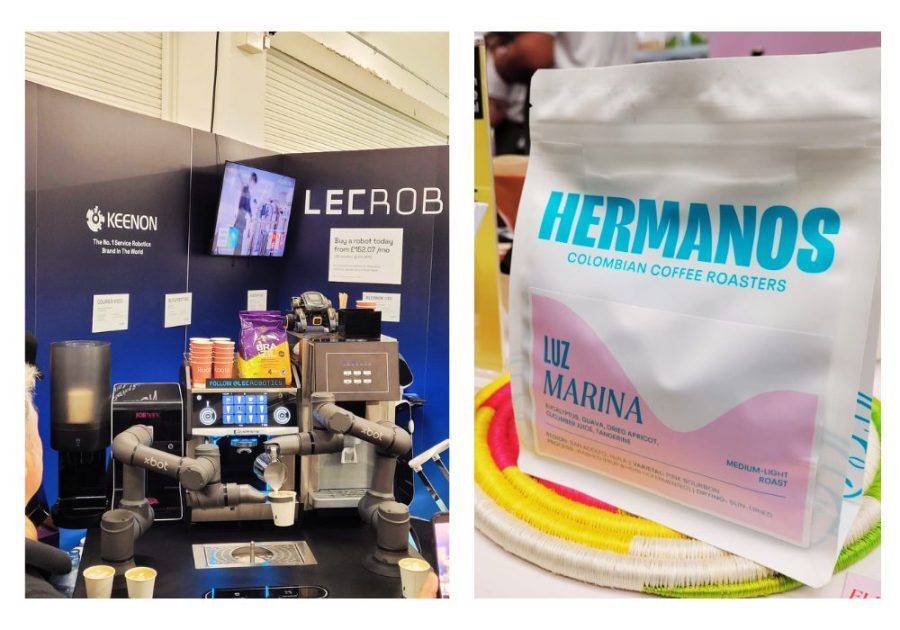
The first thing I saw when walking into the London Coffee Festival this year was not a barista pulling their latte art skills behind a polished chrome machine. It was a robot.
By the entrance, crowds were gathered around an exhibitor displaying an automated coffee system capable of preparing drinks and even pouring latte art with high precision. It was impossible not to notice the mechanical arms moving around while visitors filmed the process on their phones, half fascinated and half wondering whether they were looking at the future of cafés (I assumed).
This immediately set the tone for what would be my first time at the festival: this was not just about coffee. It was about technology, culture, wellness, experimentation and the constantly evolving ways people connect through a cup.
Held once again at The Truman Brewery in East London, the London Coffee Festival (14-17 May) brought together hundreds of exhibitors, roasters, tea and other beverage brands from around the world. But beyond the scale of the event, what stood out most was how immersive it felt.
The entire venue felt alive with conversation and caffeine. Every stand seemed eager to showcase their products, and to tell a story either about sourcing, sustainability, brewing methods or innovation.
Among all the exhibitors, one that particularly stood out was Hermanos Colombian Coffee Roasters.
Their roasting process and blends challenged the traditional expectations many people still have about black coffee. Through co-fermentation techniques, they showcased coffees with notes that felt naturally sweet, smooth and layered. Flavours that removed much of the bitterness people often try to mask with sugar, or milk.
For someone raised in a Portuguese coffee culture, this was genuinely eye-opening.
In Portugal, coffee is almost sacred in its simplicity. It is small, strong and unapologetically black. A coffee means an espresso-sized cup shared over a long conversation that somehow stretches for two hours (or a whole afternoon). It is an excuse to meet after lunch, to catch up with friends, to sit outside a café on a sunny afternoon or to go on a first date.
Milk-based coffees exist, of course, but mostly in the morning or alongside an afternoon pastel de nata. The default coffee experience in Portugal is still a sugarless espresso — can be quick to order, slow to drink, or for those who need the extra boost, served with touch of Portuguese brandy known as ‘Bagaço’.
That is why walking through the London Coffee Festival felt so fascinating. It showed coffee being appreciated in ways I had never really considered before.
Some exhibitors focused on functional wellness drinks infused with ingredients like lion’s mane mushroom or ashwagandha. Others showcased ready-to-drink canned coffees designed for convenience and younger consumers. There were automated brewing systems, precision grinders, sustainability-focused startups and alternative brewing concepts that blurred the line between coffee, tea and lifestyle beverages.
Yet despite all the innovation, the emotional core of coffee remained exactly the same.
People still gathered around cups to talk. Even surrounded by robotics and AI-assisted machinery, coffee continued to do what it has always done best: create moments of connection.
That is perhaps what the London Coffee Festival captures so well. Coffee is not static. It evolves with generations, trends and technology while still holding onto its roots. For some, it is still a quick espresso at the counter before work. Or a takeaway on a reusable cup as a sacred routine.
Leaving the festival, I realised the event was more than just a caffeine buzz and business networking. It was about how coffee has embedded itself into modern culture, adapting constantly while remaining one of the simplest ways humans continue to gather, pause and connect with each other.