
GUEST BLOG: Can coffee survive the EU’s Deforestation deadline?
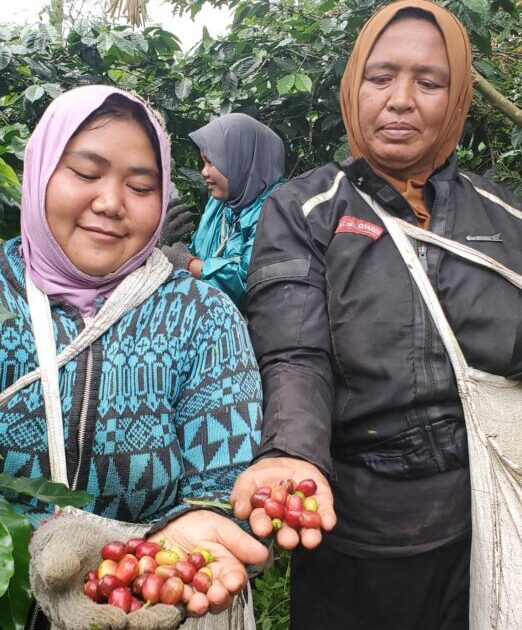
Image: Coffee pickers in Indonesia, Credit: Vanessa L Facenda
The much-discussed European Union Deforestation Regulation (EUDR) is expected to take full effect by the end of 2025, and the global coffee industry is facing a moment of reckoning. What was, until recently, being debated as a distant policy issue has now become a rapidly approaching compliance challenge with very real implications on the livelihoods of millions of smallholder farmers around the world. As new traceability and regulatory compliance become mandatory for suppliers to the European Union (EU), a growing divide is emerging between those who are equipped to meet the regulatory guidelines and those who risk falling out of the supply chain altogether.
Don’t get me wrong, at its core, the regulation aims to reduce the EU’s contribution to global deforestation and forest degradation by requiring proof that relevant commodities must not have been produced on land that was deforested after December 31, 2020. While the goals are commendable, the pace and scope of implementation, however, threaten to sideline producers and suppliers who lack the necessary capital, technical infrastructure, knowledge and related support to prove said compliance. In many regions of the world, smallholder coffee farmers are already operating on razor-thin margins. Now, with EUDR, they are being asked to produce proof of deforestation risk assessment and end-to-end traceability reports without the necessary tools or training to do so.
This is not just a logistical problem, it’s a structural one. This needs to be viewed as more than just a logistical hurdle. It’s a critical moment to reimagine how sustainability-focused policies can be implemented. The EUDR presents an opportunity to make a tangible impact towards protecting the world’s forests and reducing the EU’s deforestation footprint. While the ambition should be applauded, for it to succeed, the regulation must also factor in the capabilities and challenges of the global supply chains. Many smallholder farmers, particularly in developing regions, continue to lack the infrastructure or technical support necessary to ensure compliance with such global regulations. This isn’t a failure of intent but a gap in enablement that must be urgently bridged. By investing in the right systems and technology to support compliance, the EU has a unique opportunity to turn a global challenge into a shared success story, one that brings the farms and producers along rather than leaving them behind.
Indonesia comes as a perfect case study at this point. As the world’s fourth-largest coffee-producing country, with an estimated 1.8 million smallholder coffee farmers across the country, Indonesia is now struggling to meet the EUDR compliance benchmarks. The current challenge being faced on the ground continues to be that the majority of farmers do not have access to tools
like satellite mapping, digital farming records, and third-party verification systems, among other requirements. Without these technologies in place, they risk being cut off from European buyers, not because their practices are unsustainable but because their farms have not been digitally documented and vetted for EUDR compliance. This is essentially where the overall disconnect lies: a regulation built on visibility is being imposed on those who have historically been invisible in global coffee supply chains.
The crisis here is not only that the producers and suppliers will risk being excluded from European trade, but that the coffee industry will end up regressing into a system where only the resource-rich players can afford to be compliant. If left unchecked, this could lead to potential coffee monopolies being created that decide global price movements, create loss of income and supply chain exclusion for smallholder farmers, and unintended consequences for developing economies that are already grappling with the challenges imposed by climate change and supply chain volatility. More importantly, it would mark a significant setback for the very sustainability goals that EUDR aims to advance.
But this future isn’t inevitable. There are ways to ensure compliance that don’t rely on overhauling agricultural systems or replacing smallholder farmers altogether with larger producers or corporate estates. We are seeing early signs of success in regions like Honduras where the right technology is being leveraged in a timely manner with the right education, the tools that empower smallholder farmers to map their land, track soil and crop health and prove deforestation-free production of coffee in a way that is affordable, accessible and scalable.
What is missing in current conversations is a clear bridge between policy ambition and ground-level implementation. If the EU is serious about reducing its global contribution to deforestation, it also needs to be serious about investing in necessary tools and establishing partnerships that can support source countries. This means treating compliance towards EUDR as a global collaboration rather than a top-down mandate and recognising the invaluable role that smallholder farmers across the globe play in shaping the future of coffee as a commodity. With EUDR, the future of coffee can be sustainable, transparent, and deforestation-free, however, getting there requires more than just regulation. It requires commitment, collaboration, and a willingness to meet smallholder farmers where they are, not where the EU wants them to be.
Jon Trask is CEO and founder of Dimitra and has been working with blockchain since 2017. Prior to founding Dimitra, he had an extensive career building and developing enterprise software solutions to revolutionise supply chain processes and improve immutable traceability. A recognised expert in his field, Trask is also founder and CEO of Blockchain Guru and a partner with the Blockchain Training Alliance. Trask’s mission now is to increase farming connectivity, particularly with those disenfranchised across the globe, and to leverage the power of innovative technologies to bridge farming and technology.
